 |
 |
 |

 |
 Another Story of US Residency (1)
Part1 The 1950s to the 1970s
To date, U.S. residency programs have been introduced in various books and reports. Having completed a residency in Family Medicine in New York in the early 1980s myself, I have also provided countless introductions to these programs through articles and lectures. It seems that nearly 100% of these introductions focus on the “bright side” of U.S. residencies. For example, these include the excellence of the mentoring system, the wide variety of cases one can experience, and the quality control mechanisms in place for educational programs. Even the intensity of the training has been romanticized, viewed as a means to build confidence upon overcoming it or as a way to understand one’s own limits.
Given the history of young doctors inspired by these descriptions traveling to the U.S., developing into outstanding clinicians and educators, and returning to Japan, this focus on the “bright side” appears to have been beneficial. Conversely, looking at current trends in the U.S. medical education sector, it appears that there is not necessarily complete satisfaction with the current system.
Since 2004, postgraduate training has become mandatory in Japan as well, and there is no doubt that the U.S. residency system-the one most frequently cited in Japan-serves as a reference point. However, if we unconditionally adopt every aspect of the U.S. residency system without understanding its “shadows,” it could lead to problems down the road. For this reason, I would like to examine the U.S. residency system, tracing its history back to its establishment in the post-World War II era. While I would ideally present both the “light” and the “shadow,” since the “light” has already been thoroughly discussed, this article will naturally focus primarily on describing the “shadow.” The 1950s, when the postwar chaos had subsided and society began to stabilize, can be considered the “period of rapid economic growth” in the United States. In the field of medicine as well, postgraduate residency programs began to take shape. However, this was also an era when many so-called GPs (general practitioners) were active without having undergone residency training. Upon completing residency and passing the board exams, anyone could become a specialist?a status envied by all.
Consequently, residency (particularly the first year, formerly known as the “internship”) seemed to serve as a sort of “rite of passage” for becoming an elite physician.
“Intern”
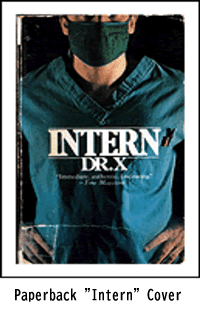 The book that must be cited first as the most faithful depiction of residency during this era is “Intern.” This book, attributed to an anonymous author, Dr. X, was published in 1965. After its publication, it garnered a huge response from the general public and remained on The New York Times bestseller list for 22 consecutive weeks.
The book states that Dr. X, who actually served as an intern, recorded his daily experiences in detail on tape after returning home, and his wife transcribed them into written form. Consequently, this work is a pure documentary and holds high value as a historical source. He undertook a rotating internship in internal medicine, surgery, obstetrics and gynecology, and pediatrics at Greystone Hospital (presumably also a pseudonym) in a certain U.S. city, and he records in concrete and vivid detail the harshness of the daily training during this time, as well as the inadequacies of medical care at that era (where most diseases could be diagnosed but not cured). It also describes instances where, when physician burnout reached its peak, doctors would crack cynical jokes in front of their pitiful patients. This is a state of mind that I, having completed my residency in the early 1980s, can well understand. Since the 1960s, Japanese doctors have also completed residencies, and there are numerous reports from those predecessors, so I won’t go into the details here. Broadly speaking, it was an extremely grueling training program, but the overall tone is highly positive, noting that by the end of the year, they had achieved remarkable growth as doctors. Regarding the harshness of the experience, a newspaper review quoted on the back cover states that “Ben Casey” and “Dr. Kildia” (both popular medical TV dramas of the time) “look like kindergarten plays” in comparison.
What I would like to highlight about this book, *Intern*, is that the author-who wrote a documentary that is not particularly controversial-chose to conceal his real name and remain anonymous. The main reason for this was likely that the U.S. medical community at the time was a highly closed, guild-like society, and residency served as a sort of “initiation rite” for joining that guild. To use a slightly exaggerated metaphor, it was perhaps akin to the initiation rites of the secretive Freemasons (Note).
The harder, the better?
If I were to summarize the motto of residency training during this era in a single phrase, “The harder, the better” (the more grueling the training, the better) would likely be the most appropriate. In the early 1980s, when the author underwent training, it was standard practice for both internal medicine and surgical residents to be on call once every three days. This meant they were required to work for over 30 consecutive hours once every three days. This alone is sufficiently grueling, but I’ve heard that until the 1970s, it was standard for first-year surgical residents to be on call every other day. Even so, surgeons reportedly boasted that “the only drawback of being on call every other day is that you can only personally handle the admission workup for half the patients.”
So, how do doctors who experienced such a rigorous residency program evaluate it? I had the opportunity to speak with a medical journalist who authored a book on the working conditions of residents. To write that book, the journalist reportedly interviewed supervising physicians at training hospitals across the country. Among them were many who had completed residencies in the United States. And apparently, almost all of them spoke highly of the grueling residencies they had undergone there. In fact, I believe that if I were to be interviewed myself, I would likely answer that it was extremely helpful in making me a better doctor.
Therefore, relying on the opinions of those who have gone through it to evaluate residencies in this era seems rather meaningless. No one wants to think of their own experience?especially if it was grueling?as something of little significance. Furthermore, past experiences are generally romanticized.
However, it is said that without exception, every respondent answered, “I would never want to repeat that experience.”
(This section continues)
Note: Formed in early 18th-century England, originating from medieval guilds of master stonemasons. Grounded in the spirit of the Enlightenment, it is said to include many prominent figures worldwide among its members today; however, its full scope remains unclear, and it is said to possess strong elements of a secret society.
References
1) Dr. X: Intern. Harper & Row, 1965 (apparently out of print)
2) Brooklyn Memoire:https://www.carefriends.com/kido/newyork/english.html
To date, U.S. residency programs have been introduced in various books and reports. Having completed a residency in Family Medicine in New York in the early 1980s myself, I have also provided countless introductions to these programs through articles and lectures. It seems that nearly 100% of these introductions focus on the “bright side” of U.S. residencies. For example, these include the excellence of the mentoring system, the wide variety of cases one can experience, and the quality control mechanisms in place for educational programs. Even the intensity of the training has been romanticized, viewed as a means to build confidence upon overcoming it or as a way to understand one’s own limits.
Given the history of young doctors inspired by these descriptions traveling to the U.S., developing into outstanding clinicians and educators, and returning to Japan, this focus on the “bright side” appears to have been beneficial. Conversely, looking at current trends in the U.S. medical education sector, it appears that there is not necessarily complete satisfaction with the current system.
Since 2004, postgraduate training has become mandatory in Japan as well, and there is no doubt that the U.S. residency system-the one most frequently cited in Japan-serves as a reference point. However, if we unconditionally adopt every aspect of the U.S. residency system without understanding its “shadows,” it could lead to problems down the road. For this reason, I would like to examine the U.S. residency system, tracing its history back to its establishment in the post-World War II era. While I would ideally present both the “light” and the “shadow,” since the “light” has already been thoroughly discussed, this article will naturally focus primarily on describing the “shadow.” The 1950s, when the postwar chaos had subsided and society began to stabilize, can be considered the “period of rapid economic growth” in the United States. In the field of medicine as well, postgraduate residency programs began to take shape. However, this was also an era when many so-called GPs (general practitioners) were active without having undergone residency training. Upon completing residency and passing the board exams, anyone could become a specialist?a status envied by all.
Consequently, residency (particularly the first year, formerly known as the “internship”) seemed to serve as a sort of “rite of passage” for becoming an elite physician.
“Intern”
The book that must be cited first as the most faithful depiction of residency during this era is “Intern.” This book, attributed to an anonymous author, Dr. X, was published in 1965. After its publication, it garnered a huge response from the general public and remained on The New York Times bestseller list for 22 consecutive weeks.The book states that Dr. X, who actually served as an intern, recorded his daily experiences in detail on tape after returning home, and his wife transcribed them into written form. Consequently, this work is a pure documentary and holds high value as a historical source. He undertook a rotating internship in internal medicine, surgery, obstetrics and gynecology, and pediatrics at Greystone Hospital (presumably also a pseudonym) in a certain U.S. city, and he records in concrete and vivid detail the harshness of the daily training during this time, as well as the inadequacies of medical care at that era (where most diseases could be diagnosed but not cured). It also describes instances where, when physician burnout reached its peak, doctors would crack cynical jokes in front of their pitiful patients. This is a state of mind that I, having completed my residency in the early 1980s, can well understand. Since the 1960s, Japanese doctors have also completed residencies, and there are numerous reports from those predecessors, so I won’t go into the details here. Broadly speaking, it was an extremely grueling training program, but the overall tone is highly positive, noting that by the end of the year, they had achieved remarkable growth as doctors. Regarding the harshness of the experience, a newspaper review quoted on the back cover states that “Ben Casey” and “Dr. Kildia” (both popular medical TV dramas of the time) “look like kindergarten plays” in comparison.
What I would like to highlight about this book, *Intern*, is that the author-who wrote a documentary that is not particularly controversial-chose to conceal his real name and remain anonymous. The main reason for this was likely that the U.S. medical community at the time was a highly closed, guild-like society, and residency served as a sort of “initiation rite” for joining that guild. To use a slightly exaggerated metaphor, it was perhaps akin to the initiation rites of the secretive Freemasons (Note).
The harder, the better?
If I were to summarize the motto of residency training during this era in a single phrase, “The harder, the better” (the more grueling the training, the better) would likely be the most appropriate. In the early 1980s, when the author underwent training, it was standard practice for both internal medicine and surgical residents to be on call once every three days. This meant they were required to work for over 30 consecutive hours once every three days. This alone is sufficiently grueling, but I’ve heard that until the 1970s, it was standard for first-year surgical residents to be on call every other day. Even so, surgeons reportedly boasted that “the only drawback of being on call every other day is that you can only personally handle the admission workup for half the patients.”
So, how do doctors who experienced such a rigorous residency program evaluate it? I had the opportunity to speak with a medical journalist who authored a book on the working conditions of residents. To write that book, the journalist reportedly interviewed supervising physicians at training hospitals across the country. Among them were many who had completed residencies in the United States. And apparently, almost all of them spoke highly of the grueling residencies they had undergone there. In fact, I believe that if I were to be interviewed myself, I would likely answer that it was extremely helpful in making me a better doctor.
Therefore, relying on the opinions of those who have gone through it to evaluate residencies in this era seems rather meaningless. No one wants to think of their own experience?especially if it was grueling?as something of little significance. Furthermore, past experiences are generally romanticized.
However, it is said that without exception, every respondent answered, “I would never want to repeat that experience.”
(This section continues)
Note: Formed in early 18th-century England, originating from medieval guilds of master stonemasons. Grounded in the spirit of the Enlightenment, it is said to include many prominent figures worldwide among its members today; however, its full scope remains unclear, and it is said to possess strong elements of a secret society.
References
1) Dr. X: Intern. Harper & Row, 1965 (apparently out of print)
2) Brooklyn Memoire:https://www.carefriends.com/kido/newyork/english.html